The quadratic formula, explained visually
The quadratic formula, x = (−b ± √(b² − 4ac)) / 2a, gives the solutions of any quadratic equation ax² + bx + c = 0 with a ≠ 0. The real solutions are where the parabola y = ax² + bx + c meets the x-axis. For x² − 2x − 3 = 0, a = 1, b = −2 and c = −3, so x = (2 ± √16) / 2: x = 3 or x = −1.
x equals negative b, plus or minus the square root of b² − 4ac, all divided by 2a. It gives the solutions of ax² + bx + c = 0 for any numbers a, b and c with a not equal to 0.
Updated
Concept map
9 ideas, in the order to learn them. Click one and Zidna draws and narrates an animated lesson on it.
Quadratic Equations and the Quadratic Formula
What the quadratic formula says, where it comes from and what it shows on a parabola: the solutions as x-intercepts, the discriminant's count of real solutions, the vertex halfway between the roots, and the formula at work on real problems.
Quadratics That Don't Factor
Quadratic equations such as x² − 4x + 1 = 0 that have solutions but no whole-number factors to find them with.Generate lesson2Parabolas and x-Intercepts
The points where a parabola meets the x-axis; their x-values solve the equation ax² + bx + c = 0.Generate lesson3Completing the Square
Rewriting x² + bx as (x + b/2)² − (b/2)² by adding the corner that a square is missing.Generate lesson4The Quadratic Formula
x = (−b ± √(b² − 4ac)) / 2a, which gives the solutions of any ax² + bx + c = 0 with a ≠ 0.Builds on Quadratics That Don't Factor, Parabolas and x-Intercepts, Completing the SquareGenerate lesson5Using the Quadratic Formula
Solving a quadratic step by step: standard form, then a, b and c, then substitute and simplify both answers.Builds on The Quadratic FormulaGenerate lesson6The Discriminant
The number b² − 4ac under the square root, which says whether there are two, one or no real solutions.Builds on The Quadratic FormulaGenerate lesson7Roots and the Axis of Symmetry
The two roots sit the same distance either side of x = −b/2a, the vertical line through the vertex.Builds on The Quadratic FormulaGenerate lesson8Projectile Motion Problems
Using h = −4.9t² + v₀t + h₀ and the quadratic formula to find when a thrown object reaches a given height.Builds on Using the Quadratic FormulaGenerate lesson9Complex Solutions
When b² − 4ac is negative, the formula gives two complex solutions, such as −1 ± 2i, and no real ones.Builds on The DiscriminantGenerate lessonKey ideas
- 01
The quadratic formula, x = (−b ± √(b² − 4ac)) / 2a, solves any quadratic equation ax² + bx + c = 0 with a ≠ 0, including ones that will not factor.
- 02
Write the equation in standard form, ax² + bx + c = 0, before reading off a, b and c. Each keeps its sign: in 2x² − 5x − 3 = 0, a = 2, b = −5 and c = −3.
- 03
The solutions of ax² + bx + c = 0 are the x-intercepts of the parabola y = ax² + bx + c: the points where its graph crosses or touches the x-axis.
- 04
The formula splits into −b/2a ± √(b² − 4ac)/2a. The first part is the parabola's axis of symmetry, and the ± steps the same distance to either side of it, so the vertex sits halfway between the two roots.
- 05
The discriminant, b² − 4ac, counts the real solutions: positive means two, zero means one repeated solution, and negative means none, with two complex solutions instead.
- 06
The quadratic formula is completing the square done once on ax² + bx + c = 0. The ± is there because a positive number has two square roots.
- 07
The two solutions add to −b/a and multiply to c/a (Vieta's formulas), a quick check: for x² − 2x − 3 = 0, the solutions 3 and −1 add to 2 and multiply to −3.
What is the quadratic formula?
The quadratic formula gives the solutions of any quadratic equation with . Put in the three numbers , and , and it returns the values of that make the equation true:
x equals negative b, plus or minus the square root of b squared minus 4ac, all divided by 2a.
The sign, read plus or minus, means there are usually two solutions: one where you add the square root and one where you subtract it. The expression under the square root, , is called the discriminant.
The formula needs the equation in standard form: every term on one side, 0 on the other. Then is the number multiplying , the number multiplying , and the number on its own, each with its sign. A missing term has a coefficient of 0.
| Equation | Standard form | a, b and c |
|---|---|---|
If the equation is not quadratic, and the formula would divide by 0. What is left, , is where the line , of slope , crosses the x-axis: .
How do you use the quadratic formula?
To use the quadratic formula, write the equation in standard form, read off , and , substitute them into the formula, then work out the plus case and the minus case separately. Finding the discriminant first keeps the arithmetic small.
- 1Write the equation as . The equation already is.
- 2Read the coefficients with their signs: , , .
- 3Find the discriminant: .
- 4Substitute: .
- 5Split the : and .
- 6Check an answer in the original equation: .
When the square root is not a whole number, simplify it, then divide every term on top by the bottom. For the discriminant is and , so , about and .
Put every substituted number in parentheses. With , is and is .
What does the quadratic formula find on a graph?
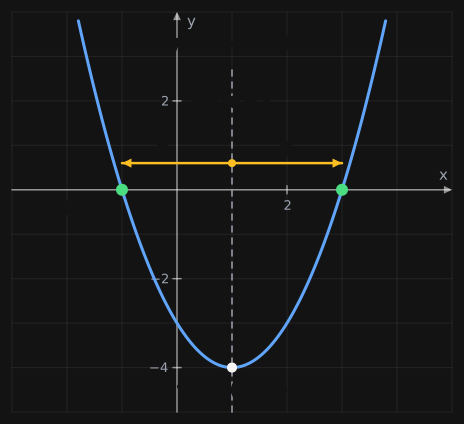
On a graph, the quadratic formula finds the x-intercepts of the parabola : the points where it crosses or touches the x-axis. Every point on the x-axis has , which turns into the equation . That is why the solutions are also called the roots or zeros of the quadratic.
Split the formula into two fractions and each part has a job on the graph:
x equals negative b over 2a, plus or minus the square root of b squared minus 4ac over 2a.
- is the parabola's axis of symmetry, the vertical line through its vertex.
- steps the same distance to each side of that line, landing on the two roots.
So the vertex of a parabola is always halfway between its two roots. For , the axis is and the distance is , so the roots are and . The vertex is at , and its height is , so the vertex is .
The vertex, at , is where the parabola is flat for an instant: its derivative, , is 0 there.
What does the discriminant tell you?
The discriminant tells you how many real solutions a quadratic equation has before you solve it, and so how many times its parabola meets the x-axis. That is where the name comes from: it discriminates, or tells apart, the three cases. It is the expression under the square root in the quadratic formula:
The discriminant is b squared minus 4 times a times c.
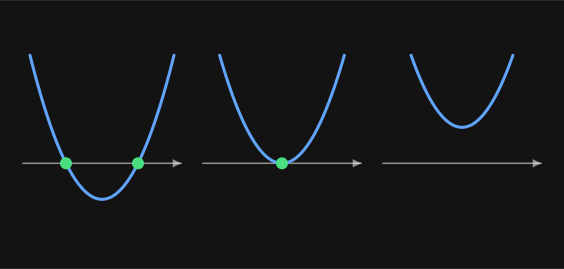
| b² − 4ac | Real solutions | The parabola | Example |
|---|---|---|---|
| Positive | Two different ones | Crosses the x-axis twice | has , so or |
| Zero | One, repeated | Touches the x-axis at its vertex | has , so |
| Negative | None (two complex ones) | Never meets the x-axis | has , so |
The reason is the square root. A positive number has two square roots, so gives two different answers. The square root of 0 is 0, so both answers land on . A negative number has no real square root at all.
When , and are whole numbers, the discriminant says more. If it is a perfect square, such as 1, 25 or 121, the solutions are whole numbers or fractions and the quadratic factors. If it is positive but not a perfect square, such as 12, the solutions are irrational and keep a square root, such as .
Read the sign of itself. Taking its square root first is unnecessary, and impossible in real numbers when it is negative.
Where does the quadratic formula come from?
The quadratic formula comes from completing the square: adding the one number that turns into a perfect square, so the equation can be solved with a single square root. The picture shows it with numbers, for .

Adding 9 to both sides of gives . Then or , so or . The picture can only show the positive length, ; the negative square root gives the second solution.
The same steps on , with letters in place of numbers, produce the formula:
- 1Divide every term by : .
- 2Move the constant to the right: .
- 3Add the square of half the coefficient, , to both sides: .
- 4Write the left side as a square and put the right side over : .
- 5Take the square root of both sides, keeping both signs: .
- 6Subtract from both sides: .
The and the discriminant both appear in the square-root step: a positive number has two square roots, and the number being rooted is .
When should you use the quadratic formula instead of factoring?
Use the quadratic formula when a quadratic does not factor quickly, when is not 1, or when the solutions might be irrational or complex. It works on every quadratic equation. Factoring is faster when it works, and taking square roots is fastest when there is no term.
| Method | Best when | Example |
|---|---|---|
| Taking square roots | There is no term () | , so |
| Factoring | Two whole numbers multiply to and add to (with ) | , so or |
| Completing the square | and is even, or you want the vertex | becomes |
| Quadratic formula | Any quadratic, especially one that will not factor | gives |
A quick test when , and are whole numbers: work out . If it is a perfect square, the quadratic factors, and either method works. If it is not, go straight to the formula. For the discriminant is , not a perfect square, so there are no whole-number factors to find.
What is the quadratic formula used for?
The quadratic formula is used whenever one quantity depends on the square of another and you need the input that gives a particular output. Some common uses:
- Physics: when a thrown or dropped object reaches a given height. Near Earth's surface, ignoring air resistance, its height in meters after seconds is , a quadratic in .
- Area: the sides of a shape with a known area. A garden 3 m longer than it is wide, with an area of 40 m², gives , so its width is m.
- Business: the break-even points of a profit that rises and then falls, where the profit is exactly 0.
- Highest and lowest values: the vertex, at , gives the maximum height of a ball or the price that brings in the most revenue.
- Matrices: the eigenvalues of a 2 × 2 matrix are the solutions of a quadratic equation.
In a real problem, check each solution against the situation. The garden equation also has the solution , and a ball's height equation usually has a negative time as a solution. Both solve the equation but not the problem, so they are dropped.
Worked examples
Rearranging into standard form first
Solve .
- 1Move every term to one side: .
- 2Read the coefficients: , , .
- 3Discriminant: , and .
- 4Substitute: .
- 5Split: and .
- 6Check in the original equation: and .
Answer: or
Two irrational solutions
Solve . Give exact answers and decimals.
- 1Read the coefficients: , , .
- 2Discriminant: . It is positive but not a perfect square, so there are two irrational solutions.
- 3Simplify the root: .
- 4Substitute: .
- 5Divide both terms on top by 2: .
- 6As decimals, with : and .
Answer: or
One repeated solution
Solve .
- 1Read the coefficients: , , .
- 2Discriminant: .
- 3With a discriminant of 0, the adds and subtracts nothing: .
- 4The quadratic is a perfect square, , and its parabola touches the x-axis only at its vertex, .
Answer: , one repeated solution
No real solutions
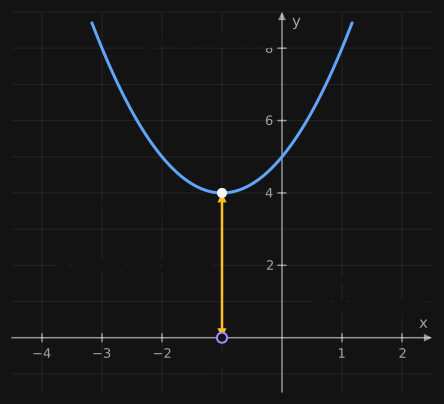
Solve .
- 1Read the coefficients: , , .
- 2Discriminant: . It is negative, so there are no real solutions: the parabola never meets the x-axis.
- 3For the complex solutions, use , the number with : .
- 4Substitute: .
- 5The real part, , is : the axis of symmetry through the vertex .
Answer: No real solutions. The two complex solutions are and .
The vertex halfway between the roots
Find the roots and the vertex of .
- 1Read the coefficients: , , . The discriminant is .
- 2Axis of symmetry: .
- 3Distance from the axis to each root: .
- 4Roots: , about and .
- 5Vertex height: .
- 6Check that the vertex is halfway: .
Answer: Roots , about and ; vertex .
When does a thrown ball land?
A ball is thrown straight up at 12 m/s from 2 m above the ground. Its height in meters after seconds is . When does it hit the ground?
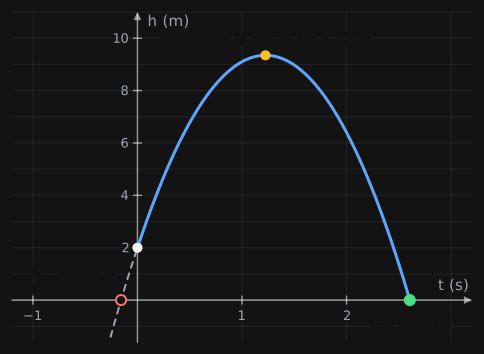
- 1The ground is , so solve , with , , .
- 2Discriminant: , and .
- 3Substitute: .
- 4Minus case: . Plus case: .
- 5A negative time is before the ball was thrown, so that solution is dropped.
- 6The highest point is at s, at a height of about m.
Answer: The ball lands after about seconds.
Check yourself
1.In 3x² − 4x + 7 = 0, what are a, b and c?Show answer
a = 3, b = −4 and c = 7. Each coefficient keeps its sign.
2.Solve x² − 5x + 6 = 0 with the quadratic formula.Show answer
x = 2 or x = 3. The discriminant is 25 − 24 = 1, so x = (5 ± 1) / 2.
3.Solve 5x = 2x² − 3.Show answer
x = 3 or x = −1/2. In standard form it is 2x² − 5x − 3 = 0, the discriminant is 25 + 24 = 49, and x = (5 ± 7) / 4.
4.Solve x² − 2x − 1 = 0. Give the exact answer.Show answer
x = 1 ± √2. The discriminant is 4 + 4 = 8 and √8 = 2√2, so x = (2 ± 2√2) / 2 = 1 ± √2.
5.What is the discriminant of x² + 6x + 9 = 0, and what does it tell you?Show answer
36 − 36 = 0, so there is one repeated solution, x = −3.
6.How many real solutions does 2x² + x + 3 = 0 have?Show answer
None. The discriminant is 1 − 24 = −23, which is negative.
7.Solve x² + 4x + 13 = 0.Show answer
x = −2 ± 3i. The discriminant is 16 − 52 = −36 and √(−36) = 6i, so x = (−4 ± 6i) / 2. There are no real solutions.
8.What is the axis of symmetry of y = 2x² − 12x + 7?Show answer
x = 3, because −b/2a = 12/4 = 3.
9.A parabola crosses the x-axis at x = −4 and x = 2. What is the x-coordinate of its vertex?Show answer
−1, halfway between the roots: (−4 + 2) / 2 = −1.
10.Without solving, what do the two solutions of 2x² − 7x + 3 = 0 add up to?Show answer
7/2, which is −b/a. The solutions are 3 and 1/2.
Common mistakes
- Writing as a negative number when is already negative: for , putting on top. means the opposite of . Here , so and , which gives 5 and 1.
- Squaring a negative without parentheses, so that comes out as .Square the whole number: . Type the parentheses on a calculator too. is never negative.
- Dividing only the square root by : .The fraction bar runs under the whole top: , so is divided by too.
- Reading , and before the equation is in standard form: from , taking and .Move everything to one side first: , so and .
- Losing a sign in when or is negative: for , writing the discriminant as ., so the discriminant is .
- Simplifying to .Divide every term on top by 2: .
- Writing no solution when the discriminant is negative.Write no real solutions. There are still two complex solutions, such as for .
- Working out only the plus case and giving one answer.Work out both the case and the case. A positive discriminant always means two different solutions.
Questions students ask
Is the quadratic formula the same as a quadratic equation?
No. A quadratic equation is the problem: any equation that can be written as ax² + bx + c = 0 with a ≠ 0. The quadratic formula, x = (−b ± √(b² − 4ac)) / 2a, is a tool that solves it. Factoring and completing the square are other ways to solve the same equation.
Does the quadratic formula always work?
Yes, for every equation ax² + bx + c = 0 with a ≠ 0, including ones that will not factor. When the discriminant is negative it still works, but its answers are complex numbers instead of real ones. If a = 0 the formula would divide by zero; the equation is then linear, bx + c = 0, and its solution is x = −c/b.
Why does the quadratic formula give two answers?
Because deriving it takes a square root, and a positive number has two square roots, one positive and one negative: 5² and (−5)² are both 25. That is the ± in the formula: the plus gives one solution and the minus gives the other. On the graph they are the two x-intercepts, the same distance either side of the parabola's axis of symmetry. When the discriminant is 0, the two answers are the same number.
How do you say the quadratic formula in words?
x equals negative b, plus or minus the square root of b squared minus four a c, all over two a. The words all over two a matter: 2a divides everything above it, not just the square root. A common way to memorize it is to sing those words to the tune of Pop Goes the Weasel.
Who invented the quadratic formula?
No single person. Old Babylonian clay tablets from 1800 to 1600 BC solve problems that lead to quadratic equations, and the Indian mathematician Brahmagupta wrote a general rule in words around 628 AD. Al-Khwarizmi solved quadratic equations by completing the square in the 9th century, Simon Stevin gave a rule covering all cases in 1594, and René Descartes printed cases of it in the form used today in 1637.
Can a quadratic equation have three solutions?
No. A quadratic equation has at most two solutions, because a parabola can cross the x-axis at most twice. Counting complex solutions, and counting a repeated solution twice, every quadratic equation has exactly two.
Can you use the quadratic formula for x³ or x⁴ equations?
Not directly: it solves equations whose highest power is x². An equation such as x⁴ − 5x² + 4 = 0 is quadratic in x², so substituting u = x² gives u² − 5u + 4 = 0, with u = 1 or u = 4, and then x = ±1 or x = ±2. Cubic equations need other methods, such as factoring out a root you can find; a general cubic formula exists but is much longer.
How do you put the quadratic formula in a calculator?
Work out the discriminant b² − 4ac first. Then type each solution as one line, with brackets around the whole top and around 2a: (−b + √(b² − 4ac)) ÷ (2a), then the same with − in place of +. For 2x² − 5x − 3 = 0 the discriminant is 49, so (5 + √49) ÷ (2 × 2) = 3 and (5 − √49) ÷ (2 × 2) = −0.5. Without the brackets, the calculator divides only the square root, or divides by 2 and then multiplies by a. Square a negative b in brackets too: (−5)² = 25, but −5² comes out as −25.
What if b or c is zero?
The formula still works, but there is a faster way. If c = 0, factor out x: x(ax + b) = 0, so x = 0 or x = −b/a. If b = 0, solve by square roots: x² = −c/a, so x = ±√(−c/a), which is real only when −c/a is 0 or positive.
Is the discriminant the same as the determinant?
No. The discriminant, b² − 4ac, belongs to a quadratic and decides how many real solutions it has. A determinant is a number calculated from a square matrix. They meet in one place: the eigenvalues of a 2 × 2 matrix are the solutions of a quadratic equation, and its discriminant decides whether they are real.
Sources
Keep going
All math topicsAlgebra
How to find the slope of a line
To find the slope of a line, take two points on it and divide the change in y (the rise) by the change in x (the run): slope = (y₂ − y₁) ÷ (x₂ − x₁). For (1, 1) and (5, 4), the slope is (4 − 1) ÷ (5 − 1) = 3/4. If the equation is written as y = mx + b, the slope is m.
Calculus
What is a derivative?
A derivative is the slope of a curve at a single point: how fast the function's output is changing at that exact input. Draw a line through two points on the curve and slide one point toward the other; the slope the line settles on is the derivative. For f(x) = x², the derivative is 2x, so the slope is 2 at x = 1.
Linear Algebra
Eigenvalues and eigenvectors, explained visually
An eigenvector of a square matrix A is a nonzero vector that A only stretches, shrinks or flips, never turning it off its own line: Av = λv. The number λ is its eigenvalue, the factor it is scaled by. To find them, solve det(A − λI) = 0 for λ, then solve (A − λI)v = 0 for v.