Eigenvalues and eigenvectors, explained visually
An eigenvector of a square matrix A is a nonzero vector that A only stretches, shrinks or flips, never turning it off its own line: Av = λv. The number λ is its eigenvalue, the factor it is scaled by. To find them, solve det(A − λI) = 0 for λ, then solve (A − λI)v = 0 for v.
A times v equals lambda times v: applying the matrix A to the eigenvector v gives the same result as multiplying v by the number lambda, its eigenvalue.
Updated
Concept map
9 ideas, in the order to learn them. Click one and Zidna draws and narrates an animated lesson on it.
Eigenvalues and Eigenvectors
What eigenvalues and eigenvectors are: the directions a matrix leaves on their own line, and the factors it scales them by. It starts from matrices as motions of the plane and the determinant, finds eigenvalues with the characteristic equation and eigenvectors by solving (A − λI)v = 0, then covers repeated and complex eigenvalues, diagonalization and principal component analysis.
Matrices as Linear Transformations
A 2×2 matrix as a rule that moves every vector in the plane, keeping grid lines straight, parallel and evenly spaced.Generate lesson2Eigenvectors and Their Eigenvalues
An eigenvector is a nonzero vector that a matrix only scales, Av = λv; its eigenvalue λ is the scale factor.Builds on Matrices as Linear TransformationsGenerate lesson3The Determinant
The factor by which a matrix scales area; it is 0 exactly when the matrix flattens the plane onto a line or a point.Builds on Matrices as Linear TransformationsGenerate lesson4Finding Eigenvectors
Solving (A − λI)v = 0 for a known eigenvalue λ, to get the line of vectors that the matrix A scales by λ.Builds on Eigenvectors and Their EigenvaluesGenerate lesson5Principal Component Analysis
A method that finds the directions in which a data set varies most, as the eigenvectors of its covariance matrix.Builds on Eigenvectors and Their EigenvaluesGenerate lesson6The Characteristic Equation
The equation det(A − λI) = 0, whose solutions are exactly the eigenvalues of the matrix A.Builds on Eigenvectors and Their Eigenvalues, The DeterminantGenerate lesson7Repeated Eigenvalues
An eigenvalue that is a double root of the characteristic equation, giving either one line of eigenvectors or every vector.Builds on The Characteristic Equation, Finding EigenvectorsGenerate lesson8Diagonalization
Writing a matrix as A = PDP⁻¹, with its eigenvectors as the columns of P and its eigenvalues on the diagonal of D.Builds on Finding Eigenvectors, The Characteristic EquationGenerate lesson9Complex Eigenvalues
Eigenvalues that are not real numbers, which a real 2×2 matrix has when it turns every direction in the plane.Builds on The Characteristic EquationGenerate lessonKey ideas
- 01
An eigenvector of a square matrix is a nonzero vector that only scales: . It stays on its own line through the origin, while most vectors are turned off theirs.
- 02
The eigenvalue is the scale factor: above it stretches the eigenvector, between and it shrinks it, a negative flips it, and sends it to the origin.
- 03
Eigenvalues are the solutions of the characteristic equation . For a 2×2 matrix it is a quadratic: .
- 04
For each eigenvalue, the eigenvectors are the nonzero solutions of . Any nonzero multiple of an eigenvector is an eigenvector for the same eigenvalue.
- 05
The eigenvalues of a matrix add up to its trace and multiply to its determinant. For they are and : and .
- 06
A real 2×2 matrix has two different real eigenvalues, one repeated eigenvalue, or a complex pair. A 90° rotation has the complex pair : it turns every direction, so no real vector keeps its line.
What is an eigenvector, in simple terms?
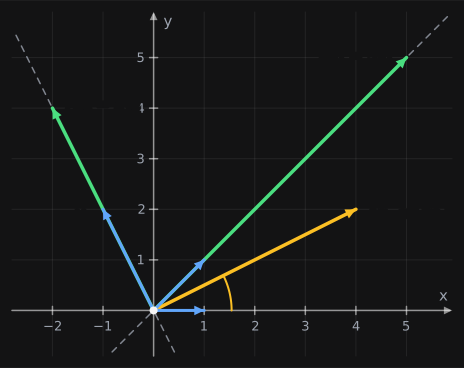
An eigenvector of a matrix is a direction the matrix does not turn. Multiply an eigenvector by the matrix and the result lies on the same line through the origin, only longer, shorter or pointing the other way. The eigenvalue is the number the eigenvector gets multiplied by.
To see it, treat a 2×2 matrix as a motion of the whole plane. Multiplying by sends every vector to a new vector. The origin stays put, and grid lines stay straight, parallel and evenly spaced, but the grid can be stretched, sheared, rotated, flipped, or even flattened onto a line. The first column of is where lands, and the second column is where lands.
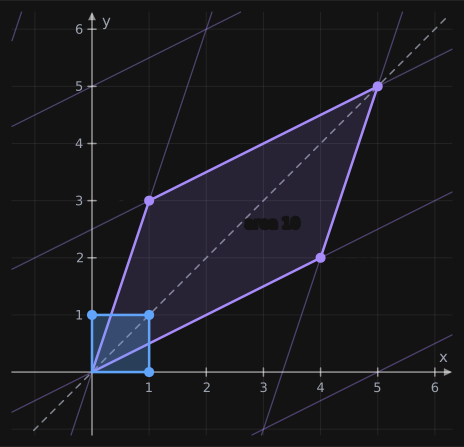
Most vectors change direction. Under , the vector lands on and lands on , both turned off their lines. But lands on , which is : the same line, five times as long. So is an eigenvector of , with eigenvalue .
A times v equals lambda times v. Applying the matrix A to the eigenvector v gives the same vector as multiplying v by the number lambda.
- must be a square matrix, so that and have the same size and can be compared.
- must be nonzero. The zero vector satisfies for every , so it tells you nothing.
- can be any number: positive, negative, zero, or even complex.
- Every nonzero multiple of an eigenvector is also an eigenvector, with the same eigenvalue: and work as well as .
An eigenvector really stands for a whole line through the origin: the matrix sends every point of that line to a point on the same line. The eigenvalue says what the matrix does along that line: how much it stretches, and whether it flips.
What do eigenvalues mean?
An eigenvalue tells you what a matrix does along one of its eigenvectors: how much it stretches or shrinks that direction, and whether it flips it. Its size is the stretch factor and its sign says which way the eigenvector ends up pointing.
| Eigenvalue | What happens to v | Example |
|---|---|---|
| Stretched, same direction | : | |
| Left exactly where it is | A mirror line under a reflection | |
| Shrunk, same direction | : | |
| Sent to the origin | The matrix flattens the plane | |
| Flipped to point the other way, then scaled by | : | |
| Not a real number | No real eigenvector: every direction is turned | A 90° rotation: |
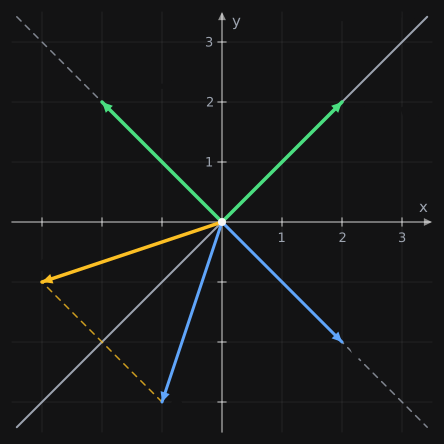
Eigenvalues also describe the whole matrix at once. Their product is the determinant, which measures how the matrix scales area, and their sum is the trace, the sum of the diagonal entries. A matrix with eigenvalues and stretches one direction 5 times and another 2 times, so it scales area by .
Under repeated multiplication, eigenvalues decide what survives. Each time is applied, an eigenvector is multiplied by its eigenvalue again, so . Directions with grow, directions with shrink toward the origin, and the direction whose eigenvalue is largest in size usually takes over in the long run.
An eigenvalue of means the matrix sends a whole line of vectors to the origin. That happens exactly when the determinant is , so a matrix has an inverse exactly when is not one of its eigenvalues.
How do you find the eigenvalues of a 2x2 matrix?
Solve the characteristic equation , where is the identity matrix. For a 2×2 matrix it is a quadratic equation in , and its solutions are the eigenvalues.
Here is why it works. Subtract from both sides of and factor out , writing as so it is a matrix: . For a nonzero to solve this, the matrix has to send a nonzero vector to the origin, and a matrix does that exactly when its determinant is .
The determinant of A minus lambda times the identity matrix equals zero.
For , subtracting takes off each diagonal entry, and the determinant expands to a quadratic built from the trace and the determinant :
The determinant of A minus lambda I is (a − λ)(d − λ) − bc, which expands to lambda squared, minus (a + d) times lambda, plus (ad − bc). Set it equal to zero.
- 1Subtract from each entry on the main diagonal of . Leave the other entries alone.
- 2Take the determinant: .
- 3Expand and set it equal to : .
- 4Solve the quadratic by factoring, or with the quadratic formula when it doesn't factor.
- 5Check that the two eigenvalues add up to and multiply to .
For : , so the eigenvalues are and . Check: , and .
The quadratic formula gives both eigenvalues of any 2×2 matrix straight from its trace and determinant :
Lambda equals T plus or minus the square root of T squared minus 4D, all over 2, where T is the trace a + d and D is the determinant ad − bc.
Only the diagonal changes in . The identity matrix has s on its diagonal and s everywhere else, so has on the diagonal and nothing off it.
How do you find eigenvectors from eigenvalues?
For each eigenvalue , solve . Because , the equations are not independent: for a 2×2 matrix, one row of is a multiple of the other, so one equation is enough, and every nonzero solution is an eigenvector.
- 1Write for the eigenvalue .
- 2Take a row with a nonzero entry and write it as an equation in and .
- 3Choose a convenient value for one variable and solve for the other. Whole numbers keep it clean.
- 4Check that .
| Eigenvalue λ | A − λI | Row 1 says | Eigenvector v | Check: Av |
|---|---|---|---|---|
| , so | ||||
| , so |
A shortcut for a 2×2 matrix : if , then is an eigenvector for the eigenvalue . For , where and , gives and gives , the same line as . If but , use instead.
Eigenvectors are not unique. , and all lie on the same eigenvector line, and calculators often scale an eigenvector to length . Two answers match if one is a nonzero multiple of the other.
Can eigenvalues be negative, zero, repeated or complex?
Yes. Eigenvalues can be negative, zero, repeated or complex. A negative eigenvalue flips its eigenvector, an eigenvalue of sends its eigenvector to the origin, a repeated eigenvalue is a double root of the characteristic equation, and complex eigenvalues come from a characteristic equation with no real roots. For a 2×2 matrix with trace and determinant , the sign of says whether the eigenvalues are two different real numbers, one repeated real number, or a complex pair.
| T² − 4D | Eigenvalues | Real eigenvector lines | Example |
|---|---|---|---|
| Positive | Two different real numbers | Two | : and |
| Zero | One real number, repeated | One, or every line if | : twice |
| Negative | A complex pair | None | : |
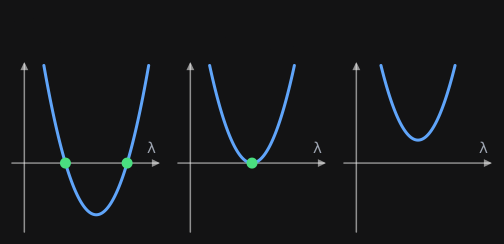
Negative. The reflection across the line has eigenvalue : it flips every vector on the line to point the opposite way. A negative eigenvalue still keeps its eigenvector on its own line.
Zero. The matrix has determinant and eigenvalues and . It sends every multiple of to the origin. An eigenvalue can be ; an eigenvector can never be the zero vector.
Repeated. The shear slides each horizontal line of the plane sideways by its height. Its characteristic equation is , so is a repeated eigenvalue, yet only the -axis stays on its line. The matrix also has a repeated eigenvalue, , and every nonzero vector is an eigenvector of it.
Complex. A rotation by 90°, , turns every vector, so no real vector keeps its line. Its characteristic equation has the solutions and . The complex eigenvalues of a real matrix always come in conjugate pairs like this.
What are the eigenvalues of a diagonal, triangular or symmetric matrix?
For a diagonal or triangular matrix, the eigenvalues are the entries on the main diagonal, so there is nothing to solve. A symmetric matrix of real numbers, one equal to its own transpose, always has real eigenvalues, and its eigenvectors for different eigenvalues are perpendicular.
The diagonal shortcut works because is still triangular, and the determinant of a triangular matrix is the product of its diagonal entries. For , the characteristic equation is .
| Matrix | Eigenvalues | Eigenvectors |
|---|---|---|
| Diagonal: | The diagonal entries, and | The axes: and |
| Triangular: | The diagonal entries, and | and |
| Symmetric: | Always real: and | Perpendicular: and |
| The identity matrix | , repeated | Every nonzero vector |
| The inverse | for each eigenvalue of | The same as 's |
| A power | for each eigenvalue of | Every eigenvector of , and sometimes more |
| A shift | for each eigenvalue of | The same as 's |
Perpendicular means a dot product of zero: . The dot product page shows why a zero dot product means a right angle. A 2×2 matrix that is not symmetric can't have two perpendicular eigenvector lines: for , .
The eigenvalues of any square matrix add up to its trace and multiply to its determinant. It is the fastest way to check an answer.
How do you find eigenvalues of a 3x3 matrix?
Use the same characteristic equation, . For a 3×3 matrix the determinant is a cubic in , so there are at most three eigenvalues, and a 3×3 matrix of real numbers always has at least one real one. The work is in expanding the determinant and factoring the cubic.
- 1Subtract from the three diagonal entries.
- 2Expand along the row or column with the most zeros, so there are fewer terms to multiply out.
- 3Factor the cubic. Keep a factor like whole when the expansion hands you one; otherwise try whole numbers that divide the constant term.
- 4For each eigenvalue that is not repeated, solve : the three equations reduce to two, which leaves one variable free to choose.
- 5Check that the three eigenvalues add up to the trace and multiply to the determinant.
For , expanding along the first row gives , so the eigenvalues are , and . They add up to , the trace , and multiply to , the determinant.
What are eigenvalues and eigenvectors used for?
Eigenvalues and eigenvectors are used wherever a matrix is applied again and again, or a system has natural directions: along an eigenvector, a matrix is plain multiplication by a number. Applying to an eigenvector times multiplies it by times.
A to the n, times v, equals lambda to the n, times v: applying A to the eigenvector v n times multiplies it by lambda to the n.
For , that means , with no matrix multiplication at all.
| Field | The matrix | What its eigenvectors and eigenvalues give |
|---|---|---|
| Statistics and machine learning: principal component analysis | A data set's covariance matrix | The eigenvectors are the directions in which the data spreads; each eigenvalue is the variance along its direction |
| Markov chains | A transition matrix, each column holding one state's probabilities of moving to each state | An eigenvector with eigenvalue , scaled so its entries add up to , is a steady state: probabilities one more step leaves unchanged |
| Web search | The Google matrix of links between web pages | The PageRank scores are the entries of its eigenvector with eigenvalue |
| Differential equations | The matrix in | Solutions grow or decay like along each eigenvector; the system is stable when every eigenvalue has a negative real part |
| Engineering: vibrations | The mass and stiffness matrices of a structure | The eigenvalues give the natural frequencies, and the eigenvectors are the shapes of the vibration modes |
| Quantum mechanics | The energy operator, or Hamiltonian | The allowed energy levels are its eigenvalues |
In principal component analysis, variance is the square of the standard deviation, so the eigenvector of the covariance matrix with the largest eigenvalue is the direction in which the data is most spread out. It is called the first principal component.
Worked examples
Eigenvalues and eigenvectors of a 2×2 matrix
Find the eigenvalues and eigenvectors of .
- 1Subtract on the diagonal: .
- 2Take the determinant: .
- 3Solve . It factors as , so or .
- 4For : . Row 1 says , so . Take .
- 5For : . Row 1 says , so . Take : .
- 6Check: , and .
Answer: Eigenvalue with eigenvector , and eigenvalue with eigenvector , or any nonzero multiples of them.
A symmetric matrix with a negative eigenvalue
Find the eigenvalues and eigenvectors of , and say what does along each eigenvector.
- 1The trace is and the determinant is , so the characteristic equation is .
- 2Factor: , so or .
- 3For : gives , so and .
- 4For : gives , so and .
- 5Check: . And : the eigenvectors are perpendicular, as they must be for a symmetric matrix.
Answer: with : stretches that line 3 times. with : flips that line end to end without changing lengths.
A repeated eigenvalue with only one eigenvector line
Find the eigenvalues and eigenvectors of .
- 1The trace is and the determinant is , so the characteristic equation is .
- 2It is a perfect square, , so the only eigenvalue is , repeated.
- 3Solve with . Both rows say , so .
- 4Every eigenvector is a multiple of . Check: .
- 5Any vector off that line is turned: , which is not a multiple of .
Answer: One eigenvalue, , repeated, with a single line of eigenvectors: the nonzero multiples of . With only one eigenvector direction, cannot be diagonalized.
Complex eigenvalues of a 90° rotation
Find the eigenvalues of , which rotates the plane 90° counterclockwise.
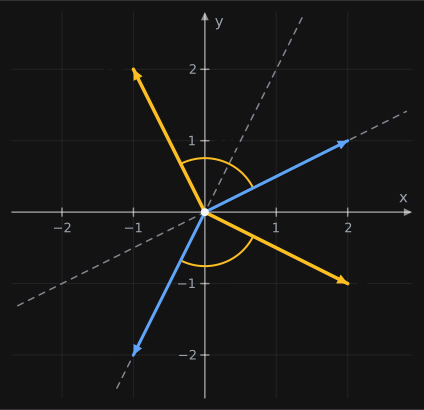
- 1, with determinant .
- 2Solve : , so or . There are no real solutions.
- 3With no real eigenvalue, no real vector stays on its line, which matches the picture: a quarter turn moves every direction.
- 4Over the complex numbers there are eigenvectors. For , row 1 of says , so and . Check: .
Answer: and , a complex conjugate pair. has no real eigenvectors; its eigenvectors, such as for , have complex entries.
Eigenvalues and eigenvectors of a 3×3 matrix
Find the eigenvalues and eigenvectors of .
- 1Expand along the first row, which has two zeros: .
- 2Simplify the bracket: .
- 3So , and the eigenvalues are , and . Check: , the trace.
- 4For : has rows , and . The last two say and , so and is free: .
- 5For : has rows , and . So and , giving : .
- 6For : has rows , and . So and , giving : .
Answer: Eigenvalue with eigenvector , eigenvalue with , and eigenvalue with .
Check yourself
1.Is (2, 2) an eigenvector of the matrix with rows (4, 1) and (2, 3)? If so, with what eigenvalue?Show answer
Yes, with eigenvalue 5: the matrix sends (2, 2) to (10, 10), which is 5 × (2, 2).
2.Is (0, 1) an eigenvector of the matrix with rows (4, 1) and (2, 3)?Show answer
No. It goes to (1, 3), which is not a multiple of (0, 1).
3.What are the eigenvalues of the matrix with rows (7, 0) and (0, −3)?Show answer
7 and −3. A diagonal matrix's eigenvalues are its diagonal entries.
4.A 2×2 matrix has trace 6 and determinant 8. What are its eigenvalues?Show answer
4 and 2, the roots of λ² − 6λ + 8 = 0.
5.What is the characteristic equation of the matrix with rows (2, 5) and (1, −2)?Show answer
λ² − 9 = 0, since the trace is 0 and the determinant is −4 − 5 = −9. The eigenvalues are 3 and −3.
6.What are the eigenvalues of the matrix with rows (3, 1) and (1, 1)?Show answer
2 + √2 and 2 − √2. The characteristic equation λ² − 4λ + 2 = 0 doesn't factor, so the quadratic formula gives them.
7.5 is an eigenvalue of the matrix with rows (1, 2) and (2, 4). Find an eigenvector for it.Show answer
(1, 2), or any nonzero multiple: the matrix sends (1, 2) to (5, 10) = 5 × (1, 2).
8.An eigenvector has eigenvalue −2. What does the matrix do to it?Show answer
It flips the vector to point the opposite way and doubles its length.
9.If 3 is an eigenvalue of A, what is the matching eigenvalue of A²?Show answer
9. If Av = 3v, then A²v = A(3v) = 3Av = 9v.
10.If 0 is an eigenvalue of a matrix, does the matrix have an inverse?Show answer
No. It sends a nonzero vector to the zero vector, so its determinant is 0.
Common mistakes
- Subtracting from every entry: writing for as . has only on the diagonal, so subtract it only from the diagonal: .
- Solving , getting only , and giving that as the eigenvector.The zero vector is never an eigenvector. For a true eigenvalue the equations always have nonzero solutions, so if elimination leaves only , recheck the eigenvalue or the subtraction.
- Reading the eigenvalues off the diagonal of any matrix: saying has eigenvalues and .That shortcut works only for diagonal and triangular matrices. Here the off-diagonal entries matter, and the eigenvalues are and ; they do still add up to .
- Row-reducing first, then finding the eigenvalues of the simpler matrix.Row operations change the eigenvalues: row-reduces to , whose eigenvalues are and , not and . Row-reduce , and only when solving for eigenvectors.
- Marking an eigenvector wrong because it differs from the answer key, such as instead of , or instead of .Any nonzero multiple of an eigenvector is an eigenvector for the same eigenvalue. Two answers agree when one is a multiple of the other.
- Slipping a sign when expanding , such as adding instead of subtracting it.Match the pattern , then check that the roots add up to the trace and multiply to the determinant .
Questions students ask
Why are they called eigenvalues and eigenvectors?
Eigen is German for own, in the sense of characteristic or proper: an eigenvector is one of a matrix's own directions. David Hilbert used the word this way in 1904, and the name stuck. Eigenvalues are also called characteristic values or characteristic roots, and the equation that finds them is the characteristic equation.
Can an eigenvector be the zero vector?
No. The zero vector satisfies A0 = λ0 for every number λ, so allowing it would make every number an eigenvalue of every matrix. Eigenvectors are nonzero by definition. An eigenvalue can be 0, though: it means the matrix sends some nonzero vector to the zero vector.
Are eigenvectors always perpendicular?
Not in general. They are guaranteed to be perpendicular for a symmetric matrix, where eigenvectors for different eigenvalues always meet at right angles. The matrix with rows (4, 1) and (2, 3) has eigenvectors (1, 1) and (−1, 2), whose dot product is 1, not 0, so they meet at about 71.6°.
Do only square matrices have eigenvalues?
Yes. The equation Av = λv compares Av with v, so the two must be the same size, and that needs A to have as many rows as columns. Rectangular matrices have singular values instead, which describe how much they stretch along their most important directions.
How many eigenvalues does a matrix have?
An n×n matrix has exactly n eigenvalues if you count repeated ones and allow complex numbers, because its characteristic equation is a polynomial of degree n. It has at most n different eigenvalues. So a 2×2 matrix has two and a 3×3 matrix has three, counted this way.
Why is the determinant the product of the eigenvalues?
The characteristic polynomial det(A − λI) factors as (λ₁ − λ)(λ₂ − λ)···(λₙ − λ), one factor for each eigenvalue. Setting λ = 0 gives det A = λ₁λ₂···λₙ. In pictures, a matrix that stretches one direction 5 times and another 2 times scales every area by 10.
What does an eigenvalue of 1 mean?
Vectors along its eigenvector are left exactly where they are: Av = v. A reflection has eigenvalue 1 along its mirror line. The transition matrix of a Markov chain, with each column holding one state's probabilities of moving to each state, always has eigenvalue 1. An eigenvector for it with no negative entries, scaled so its entries add up to 1, is a steady state: probabilities that one more step leaves unchanged.
Can two different matrices have the same eigenvalues?
Yes. The matrix with rows (4, 1) and (2, 3) and the diagonal matrix with rows (5, 0) and (0, 2) both have eigenvalues 5 and 2; they stretch by the same amounts along different directions. Eigenvalues alone don't pin down a matrix: the identity matrix and the shear with rows (1, 1) and (0, 1) both have eigenvalue 1 twice, yet the identity moves nothing.
Sources
- Interactive Linear Algebra, 5.1 Eigenvalues and Eigenvectors (Georgia Tech)
- Interactive Linear Algebra, 5.2 The Characteristic Polynomial (Georgia Tech)
- Lecture 21: Eigenvalues and Eigenvectors, MIT 18.06 Linear Algebra (MIT OpenCourseWare)
- Eigenvalue, Wolfram MathWorld
- Eigenvalues and eigenvectors, Wikipedia
Keep going
All math topicsLinear Algebra
The dot product, explained visually
The dot product of vectors a and b is a number: multiply matching components and add, so (1, 4) · (4, 3) = 1 × 4 + 4 × 3 = 16. It also equals |a||b| cos θ, the length of a's shadow on b times the length of b. It is positive when the angle θ between them is acute, zero when it is 90° and negative when it is obtuse.
Algebra
The quadratic formula, explained visually
The quadratic formula, x = (−b ± √(b² − 4ac)) / 2a, gives the solutions of any quadratic equation ax² + bx + c = 0 with a ≠ 0. The real solutions are where the parabola y = ax² + bx + c meets the x-axis. For x² − 2x − 3 = 0, a = 1, b = −2 and c = −3, so x = (2 ± √16) / 2: x = 3 or x = −1.