What is a derivative?
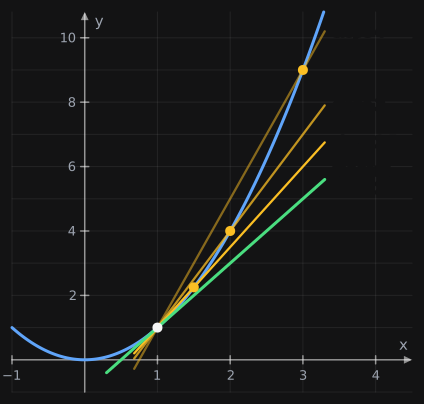
A derivative is the slope of a curve at a single point: how fast the function's output is changing at that exact input. Draw a line through two points on the curve and slide one point toward the other; the slope the line settles on is the derivative. For f(x) = x², the derivative is 2x, so the slope is 2 at x = 1.
The derivative of f at x is the limit, as h approaches 0, of the rise f(x + h) − f(x) divided by the run h.
Updated
Concept map
8 ideas, in the order to learn them. Click one and Zidna draws and narrates an animated lesson on it.
Derivatives
What a derivative is: the slope of a curve at a single point, found by sliding a secant line's two points together until it becomes the tangent line. Average rate of change and limits lead into it; the limit definition and the power rule compute it; the derivative as a function and instantaneous velocity show what it describes.
The Tangent Line Problem
The question of how steep a curve is at a single point, when the slope of a line needs two points.Generate lesson2Average Rate of Change
How much a function's output changes per unit of input between two points: the slope of the secant line through them.Generate lesson3Limits
The value a function's output approaches as its input gets closer and closer to a given number.Generate lesson4The Derivative at a Point
The slope of a function's graph at one point: the value the secant slopes approach as the second point slides into the first.Builds on The Tangent Line Problem, Average Rate of Change, LimitsGenerate lesson5The Limit Definition of the Derivative
The formula that finds a derivative from the function itself: the limit as h → 0 of (f(x + h) − f(x)) / h.Builds on The Derivative at a PointGenerate lesson6The Derivative as a Function
The function f′ that gives the slope of f's graph at every input, so the slopes have a graph of their own.Builds on The Derivative at a PointGenerate lesson7Instantaneous Velocity
How fast an object's position is changing at one instant: the derivative of its position with respect to time.Builds on The Derivative at a PointGenerate lesson8The Power Rule
The shortcut that the derivative of xⁿ is n·xⁿ⁻¹: bring the exponent down in front, then lower it by one.Builds on The Limit Definition of the Derivative, The Derivative as a FunctionGenerate lessonKey ideas
- 01
A derivative is the slope of a function's graph at a single point: the slope of the tangent line, the line that touches the curve there and runs in the same direction as the curve.
- 02
The derivative is a limit: the slope of a secant line through two points on a curve, as the second point slides into the first. On at , the secant slopes close in on .
- 03
A derivative is an instantaneous rate of change, measured in output units per input unit. The derivative of position with respect to time is velocity.
- 04
The power rule gives the derivative of any power of : . Bring the exponent down in front and lower it by one, so becomes .
- 05
The derivative is a function with its own graph: where is positive, rises; where is negative, falls; and where is , the graph of is flat, as at a peak or a valley.
Is the derivative the slope of the tangent line?
Yes. The derivative of a function at a point is the slope of the tangent line there: the line that touches the graph at that point and runs in the same direction as the curve. Zoom in far enough on a smooth curve and it looks straight; the tangent line is that straight line.
Slope needs two points, so the tangent's slope is found in two moves. First draw a secant line through the point and a second point on the curve, and find its slope, rise over run. Then slide the second point toward the first and watch where the slopes go.
| Run h | Second point | Secant slope |
|---|---|---|
Each secant slope is , so as shrinks toward the slopes close in on . That limit is the derivative: the slope of at is , and the tangent line there is .
A secant slope is an average rate of change over an interval. The derivative is the limit of those averages as the interval shrinks to a single point.
What does a derivative tell you?
A derivative tells you how fast a function's output is changing at one input, and in which direction. On the graph, it is how steep the curve is at that point. The derivative of at is written and read "f prime of a".
Its sign gives the direction and its size gives the steepness. If , the output is changing 3 times as fast as the input at : nudge up by and goes up by about .
| Derivative at a | Graph at a | Output at a |
|---|---|---|
| Rising from left to right | Increasing | |
| Falling from left to right | Decreasing | |
| Flat: the tangent line is horizontal | Not changing at that instant, as at a peak or a valley | |
| Far from | Steep | Changing fast |
| Close to | Nearly flat | Changing slowly |
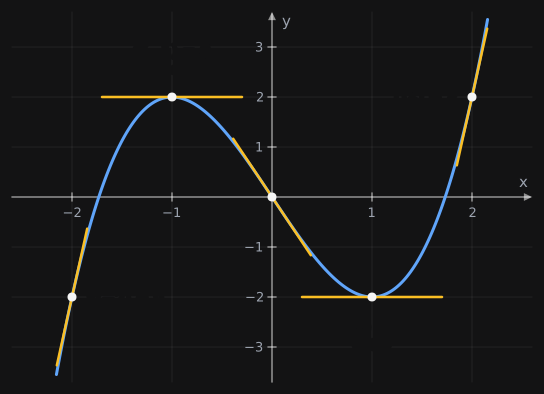
A smooth graph can only peak or bottom out where its derivative is , so solve to find its peaks and valleys. For the derivative is , which is at , the peak, and , the valley. When is a quadratic that doesn't factor, the quadratic formula finds where it is .
Is a derivative a rate of change?
Yes. A derivative is an instantaneous rate of change: how fast one quantity is changing compared with another at a single moment. An average rate of change covers an interval; the derivative is what that average becomes as the interval shrinks to an instant.
A stone dropped from a bridge has fallen meters after seconds, ignoring air resistance. Its average velocity between two times is the distance fallen divided by the time taken. Shrink the interval that starts at , and the averages settle on one number.
| Time interval | Distance fallen | Average velocity |
|---|---|---|
| 2 to 3 s | 44.1 − 19.6 = 24.5 m | 24.5 m/s |
| 2 to 2.1 s | 21.609 − 19.6 = 2.009 m | 20.09 m/s |
| 2 to 2.01 s | 19.79649 − 19.6 = 0.19649 m | 19.649 m/s |
| 2 to 2.001 s | 19.6196049 − 19.6 = 0.0196049 m | 19.6049 m/s |
The averages approach , so the stone's velocity at the instant is m/s. The units say what any derivative is: units of output per unit of input.
| Quantity | Its derivative | Units |
|---|---|---|
| Position (m) over time (s) | Velocity | m/s |
| Velocity (m/s) over time (s) | Acceleration | m/s² |
| Water in a tank (L) over time (min) | Flow rate | L/min |
| Total cost (dollars) over items made | Marginal cost | dollars per item |
Going the other way, from a rate back to a total, is the job of the integral: the area under the curve of a velocity graph is the change in position.
What is the limit definition of the derivative?
The limit definition of the derivative says that is the limit of a secant line's slope as its second point slides into the first. Put the second point units to the right of : the run is , the rise is , and the derivative is the limit of rise over run as goes to .
The derivative of f at x is the limit, as h approaches 0, of f of x plus h, minus f of x, all divided by h.
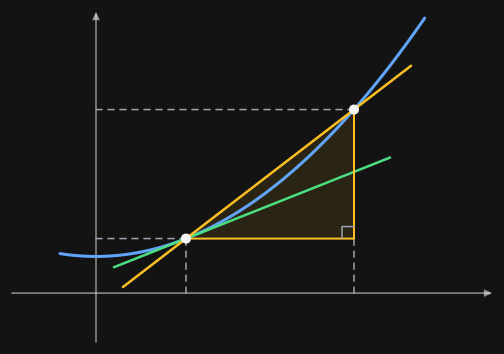
The fraction is called the difference quotient. Setting in it directly gives , which has no value, so the limit asks what the fraction approaches as gets close to without reaching it.
- 1Replace every in with to write .
- 2Subtract and simplify until is a factor of every term on top.
- 3Divide by , canceling the in the denominator.
- 4Let in what is left. The result is .
For : , which approaches as . So the derivative of is .
For the slope at one point , the same definition is often written , with the second point at instead of .
How do you find the derivative of a function?
To find the derivative of a function, apply the derivative rules, each proved once from the limit definition, instead of taking a limit every time. For powers of the key rule is the power rule: bring the exponent down in front, then lower the exponent by one.
The derivative of x to the n is n times x to the n minus 1.
| Rule | In symbols | Example |
|---|---|---|
| Constant | ||
| Power | ||
| Constant multiple | ||
| Sum and difference |
To differentiate a polynomial, or any sum of powers of :
- 1Rewrite roots and fractions as powers of : and .
- 2Differentiate term by term: multiply each coefficient by its exponent, then lower the exponent by one.
- 3Drop the constant terms, since the derivative of a constant is .
- 4Rewrite negative and fractional exponents as fractions and roots, if the answer should look like the question.
| Function | As a power of x | Derivative |
|---|---|---|
Other functions have derivatives of their own, also proved from the limit definition. Products, quotients and functions inside other functions use the product, quotient and chain rules.
| Function | Derivative |
|---|---|
| , by the chain rule | |
Differentiating a polynomial lowers its degree by one, down to a constant: a cubic's derivative is a quadratic, a quadratic's is a line, and a line's is a constant.
What does a derivative look like on a graph?
The derivative of is a new function, , and its graph shows the slope of at every . Measure the slope of at each point, plot that number as a height, and the points trace out the graph of .
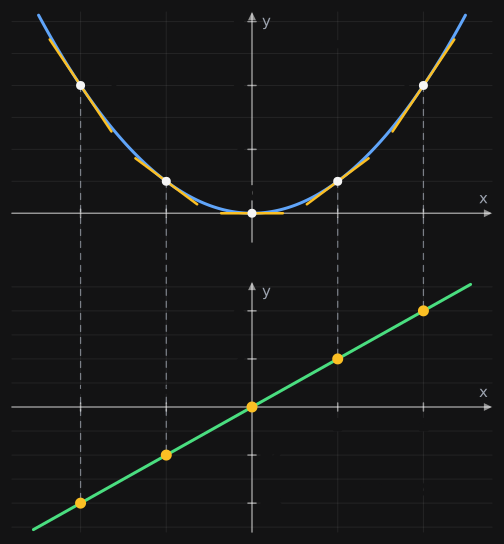
Read one graph from the other: where is above the -axis, rises; where is below it, falls; and where is , is flat, as at a peak or a valley. The parabola falls, flattens at its vertex and rises, so its derivative goes from negative through to positive.
| Graph of f | Graph of f′ |
|---|---|
| Horizontal line | The -axis, |
| Line | Horizontal line |
| Parabola | Line |
| Cubic with a peak and a valley | Parabola that crosses the -axis at the peak's and the valley's -values |
The derivative has three common notations: , read "f prime of x"; , read "d y d x", the derivative of with respect to ; and written in front of an expression, meaning "the derivative of" it.
Worked examples
The derivative of x³ from the limit definition
Use the limit definition to find the derivative of .
- 1Write : .
- 2Subtract : .
- 3Divide by : .
- 4Let : the terms and go to , leaving .
Answer: , the same result the power rule gives in one step.
Slope and tangent line at a point
Find the slope of at and the equation of the tangent line there.
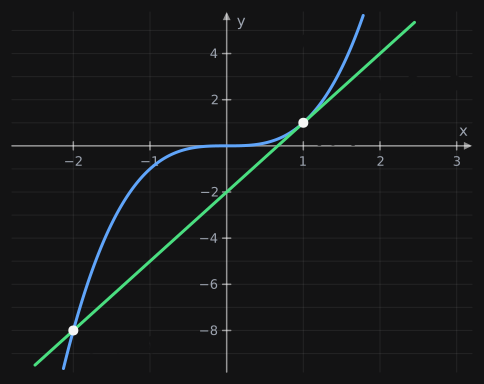
- 1Differentiate: .
- 2Substitute : the slope is .
- 3Find the point: , so the tangent line passes through .
- 4Use point-slope form: , so .
Answer: The slope is , and the tangent line is .
The power rule on a polynomial
Find for , then find .
- 1: bring the down and lower the exponent, .
- 2: .
- 3: .
- 4: a constant, so its derivative is .
- 5Add the pieces: . At : .
Answer: and : at the output is changing 35 times as fast as the input.
The power rule with a root and a fraction
Differentiate .
- 1Rewrite as powers: .
- 2First term: .
- 3Second term: . Lowering by one gives , not .
- 4Rewrite without negative exponents: and .
Answer:
Velocity from position
A ball thrown straight up at m/s has height meters after seconds, ignoring air resistance. Find its velocity at and , and when it reaches the top.
- 1Velocity is the derivative of position: .
- 2At : m/s. Positive, so the ball is rising.
- 3At : m/s. Negative, so the ball is falling.
- 4At the top the ball stops rising, so : gives , and m.
Answer: m/s upward at , m/s downward at , and the top comes at s, m up.
Check yourself
1.What is the derivative of x⁶?Show answer
6x⁵
2.What is the derivative of f(x) = 9?Show answer
0. A constant never changes, so its graph is a horizontal line with slope 0.
3.For f(x) = x², what is the slope of the tangent line at x = −3?Show answer
−6, because f′(x) = 2x.
4.The secant slopes of a curve from x = 2 to x = 2 + h are 5 + h. What is the derivative at x = 2?Show answer
5, the value 5 + h approaches as h goes to 0.
5.Differentiate 3x⁴ − 2x + 9.Show answer
12x³ − 2
6.What is the derivative of √x?Show answer
1/(2√x). Write √x as x^(1/2); the power rule gives (1/2)x^(−1/2).
7.What is the derivative of 1/x?Show answer
−1/x². Write 1/x as x^(−1); the power rule gives −x^(−2).
8.If f′(4) = 0, what does the graph of f look like at x = 4?Show answer
Flat: the tangent line there is horizontal. It may be a peak, a valley or a level point.
9.An object's position is s(t) = t³ meters after t seconds. What is its velocity at t = 2?Show answer
12 m/s, since s′(t) = 3t² and 3 × 2² = 12.
10.If f′(x) = 2x − 4, is f rising or falling at x = 1?Show answer
Falling, because f′(1) = −2 is negative.
Common mistakes
- Substituting the number before differentiating: for the slope of at , working out and then differentiating to get .Differentiate first, then substitute: , so .
- Setting at the start of the limit definition, getting , and deciding there is no derivative.Simplify until the in the denominator cancels, then let . A at the start only means the algebra isn't finished.
- Using the power rule on an exponential: writing the derivative of as .The power rule is for , a variable base with a constant exponent. In the variable is the exponent, and its derivative is .
- Differentiating as .Rewrite it as first. The power rule then gives : lowering by one gives .
- Differentiating a product factor by factor: taking the derivative of as .Multiply out first: , so the derivative is . For products that don't simplify, use the product rule.
- Thinking a tangent line touches the curve at only one point.A tangent line matches the curve's direction where it touches, and it can meet the curve again elsewhere: the tangent to at crosses the curve at .
Questions students ask
What is a derivative used for?
Derivatives measure how fast things change and find where they reach a maximum or a minimum. In physics, velocity is the derivative of position and acceleration is the derivative of velocity. A smooth graph can only peak or bottom out where its derivative is 0, which is the basis of optimization problems such as the least cost or the largest area. In economics, marginal cost and marginal revenue are derivatives.
Is the derivative the same as the slope?
For a straight line, yes: its derivative is its slope, the same number at every point. A curve's steepness changes from point to point, so its derivative is a function that gives the slope of the tangent line at each x. For y = x², the slope is −2 at x = −1 and 4 at x = 2, because the derivative is 2x.
Can a derivative be negative or zero?
Yes. A negative derivative means the function is decreasing there: its graph falls from left to right. A derivative of 0 means the tangent line is horizontal, as at a peak, a valley, or a level point like x = 0 on y = x³. A zero derivative says the graph is flat at that point, not that the function's value is 0.
When does a derivative not exist?
A derivative fails to exist where a graph has no single tangent slope. That happens at a corner, like y = |x| at x = 0, where the slope jumps from −1 to 1; at a vertical tangent, like the cube root of x at x = 0; and at a break in the graph, such as a jump or a hole. A function must be continuous at a point to have a derivative there, but being continuous is not enough on its own.
What does dy/dx mean?
dy/dx is Leibniz's notation for the derivative of y with respect to x. It echoes the slope Δy/Δx, a change in y over a change in x, in the limit where both changes shrink toward 0. When y = f(x), dy/dx and f′(x) mean the same thing.
Why is the derivative of a constant 0?
A constant function such as f(x) = 5 gives the same output for every input, so its graph is a horizontal line, and a horizontal line has slope 0 everywhere. The limit definition agrees: (5 − 5)/h = 0 for every h, so the limit is 0.
What is the difference between a derivative and an integral?
A derivative measures how fast a quantity is changing at an instant: the slope of a graph. An integral adds a quantity up over an interval: the area under a graph. The Fundamental Theorem of Calculus links them as inverse operations: integrating a rate of change over an interval gives the total change, and the derivative of an accumulated area is the function being accumulated.
Who invented the derivative?
Isaac Newton and Gottfried Wilhelm Leibniz developed calculus independently in the second half of the 1600s. Newton worked out his method of fluxions, his name for derivatives, around 1665 to 1666 but published it much later. Leibniz published first, in 1684, and the dy/dx notation he introduced is still standard.
Sources
Keep going
All math topicsAlgebra
How to find the slope of a line
To find the slope of a line, take two points on it and divide the change in y (the rise) by the change in x (the run): slope = (y₂ − y₁) ÷ (x₂ − x₁). For (1, 1) and (5, 4), the slope is (4 − 1) ÷ (5 − 1) = 3/4. If the equation is written as y = mx + b, the slope is m.
Calculus
How to find the area under a curve
The area under y = f(x) from x = a to x = b is the definite integral of f from a to b, the limit of sums of ever-thinner rectangles. It equals F(b) − F(a), where F is an antiderivative of f. For y = x² from 0 to 2, F(x) = x³/3, so the area is 8/3 ≈ 2.67. The integral counts area below the x-axis as negative.
Algebra
The quadratic formula, explained visually
The quadratic formula, x = (−b ± √(b² − 4ac)) / 2a, gives the solutions of any quadratic equation ax² + bx + c = 0 with a ≠ 0. The real solutions are where the parabola y = ax² + bx + c meets the x-axis. For x² − 2x − 3 = 0, a = 1, b = −2 and c = −3, so x = (2 ± √16) / 2: x = 3 or x = −1.