The unit circle, explained visually
The unit circle is the circle of radius 1 centered at the origin. For any angle θ, measured counterclockwise from the positive x-axis, the point where the angle meets the circle is (cos θ, sin θ): cosine is the x-coordinate and sine is the y-coordinate. At 30°, the point is (√3/2, 1/2).
The point at angle θ on the unit circle is (cos θ, sin θ), and tan θ is sin θ divided by cos θ.
Updated
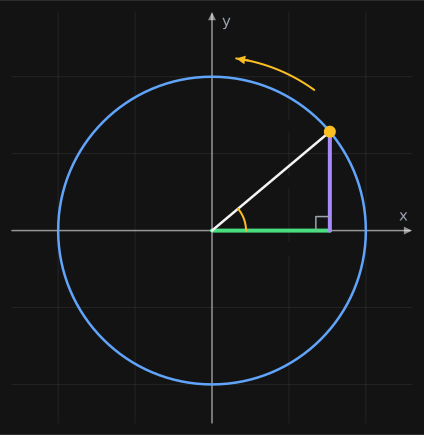
Narrated lesson · 2 min
Watch it build, one idea at a time
Press play to hear it while the picture builds, or scroll through at your own pace.
01 / 08
A circle with radius 1
Draw a circle centered at the origin with a radius of exactly 1. That one choice makes everything after it simple: on this circle, lengths and coordinates turn out to be the same thing.
02 / 08
An angle, measured from the right
Start on the positive x-axis and turn counterclockwise. How far you turn is the angle θ. Turn 40° and the radius lands on exactly one point of the circle.
03 / 08
Drop a line, find a triangle
From that point, drop straight down to the x-axis. You get a right triangle, and its longest side, the hypotenuse, is the radius. Its length is 1.
04 / 08
Cosine is across, sine is up
In a right triangle, cos θ is adjacent over hypotenuse and sin θ is opposite over hypotenuse. Dividing by 1 changes nothing, so the point's x is cos θ and its y is sin θ. At 40° that is about (0.77, 0.64).
05 / 08
Three angles worth knowing
At 30°, 45° and 60° the coordinates are exact: (√3/2, 1/2), (√2/2, √2/2) and (1/2, √3/2). Look closely: 30° and 60° just swap their x and y.
06 / 08
All the way around
Keep turning. Past 90°, x turns negative. Past 180°, so does y. Past 270°, x comes back positive. The signs of (cos θ, sin θ) tell you which quadrant you are in.
07 / 08
Unroll the height into a wave
Now follow only the point's height as the angle grows from 0° to 360°. Plotted against the angle, it traces y = sin θ: up to 1 at 90°, back to 0 at 180°, down to −1 at 270°.
08 / 08
Why cos²θ + sin²θ = 1
Every point on the circle satisfies x² + y² = 1. Put in x = cos θ and y = sin θ, and you get an identity that holds for every angle: cos²θ + sin²θ = 1. It is the Pythagorean theorem, on the circle.
That’s the whole picture.
Want it at your own level, with room to ask about any step? Zidna draws and narrates a lesson just for you.
01 / 08 · 0:00 / 2:06
A circle with radius 1
Concept map
8 ideas, in the order to learn them. Click one and Zidna draws and narrates an animated lesson on it.
The Unit Circle
How the unit circle defines sine, cosine and tangent for every angle, and how a few special angles give every exact value on its chart.
Sine and Cosine on the Unit Circle
The point at angle θ on the unit circle is (cos θ, sin θ): cosine is its x and sine is its y.Generate lesson2Special Right Triangles
The 30-60-90 and 45-45-90 triangles, with side ratios 1 : √3 : 2 and 1 : 1 : √2.Generate lesson3Radian Measure
Measuring an angle by the arc it sweeps on the unit circle, so a full turn is 2π radians.Generate lesson4Special Angles on the Unit Circle
The points at 0°, 30°, 45°, 60° and 90°, with coordinates made of 0, 1/2, √2/2, √3/2 and 1.Builds on Sine and Cosine on the Unit Circle, Special Right Triangles, Radian MeasureGenerate lesson5Graphs of Sine and Cosine
The waves y = sin x and y = cos x, traced by the y and x of a point going around the circle.Builds on Sine and Cosine on the Unit Circle, Radian MeasureGenerate lesson6Tangent on the Unit Circle
The ratio y/x = sin θ / cos θ: the slope of the line from the origin to the point at angle θ.Builds on Special Angles on the Unit CircleGenerate lesson7Reference Angles and Signs
The acute angle to the x-axis that gives an angle's values; the quadrant gives their signs.Builds on Special Angles on the Unit CircleGenerate lesson8Finding Exact Trig Values
Finding the exact sine, cosine and tangent of any special angle without a calculator.Builds on Reference Angles and Signs, Tangent on the Unit CircleGenerate lessonKey ideas
- 01
The unit circle is the circle of radius 1 centered at the origin, so every point (x, y) on it satisfies x² + y² = 1.
- 02
The point at angle θ, measured counterclockwise from the positive x-axis, is (cos θ, sin θ): cosine is its x-coordinate and sine is its y-coordinate.
- 03
Apart from the points on the axes, every exact value on the unit circle chart comes from the 30-60-90 and 45-45-90 triangles with hypotenuse 1, which give the numbers 1/2, √2/2 and √3/2.
- 04
An angle in any quadrant has its reference angle's values with the quadrant's signs: all three functions are positive in quadrant I, sine in II, tangent in III and cosine in IV.
- 05
tan θ = sin θ / cos θ = y/x, the slope of the angle's terminal side. It is undefined at 90° and 270°, where cos θ = 0.
- 06
In radians, an angle on the unit circle is the arc length it sweeps, so a full turn is 2π radians and 180° equals π radians.
What is the unit circle?
The unit circle is the circle with radius 1 and its center at the origin, (0, 0). Every point on it is exactly 1 unit from the center, so by the Pythagorean theorem every point (x, y) on it satisfies one equation.
For every point (x, y) on the unit circle, x squared plus y squared equals 1.
Trigonometry uses the circle to turn angles into numbers. An angle starts on the positive x-axis and turns counterclockwise; a negative angle turns clockwise. The side where the angle stops, its terminal side, crosses the circle at exactly one point, and that point's coordinates are the angle's cosine and sine.
On the unit circle, the point at angle θ is (cos θ, sin θ). Every number on a unit circle chart is a coordinate of one of these points.
Why is cosine x and sine y on the unit circle?
On the unit circle, cosine is the x-coordinate and sine is the y-coordinate because the radius is 1. Drop a vertical line from the point at angle θ to the x-axis. That makes a right triangle whose hypotenuse is the radius, 1, whose horizontal leg is x and whose vertical leg is y, so dividing each leg by the hypotenuse leaves it unchanged.
Cosine is adjacent over hypotenuse, x over 1, which is x. Sine is opposite over hypotenuse, y over 1, which is y.
The triangle definitions only cover angles between 0° and 90°, because the other two angles of a right triangle are acute. For every other angle, the coordinates become the definition: for any angle θ, cos θ is the x-coordinate and sin θ is the y-coordinate of its point. That is how sine and cosine take negative values. At 150° the point is left of the y-axis, so cos 150° is negative.
Because the point lies on the circle, becomes , the Pythagorean identity, true for every angle.
To keep the order straight: the point is (cos θ, sin θ), in the same order as (x, y). C comes before S in the alphabet, just as x comes before y.
Unit circle chart: degrees, radians, sin, cos and tan
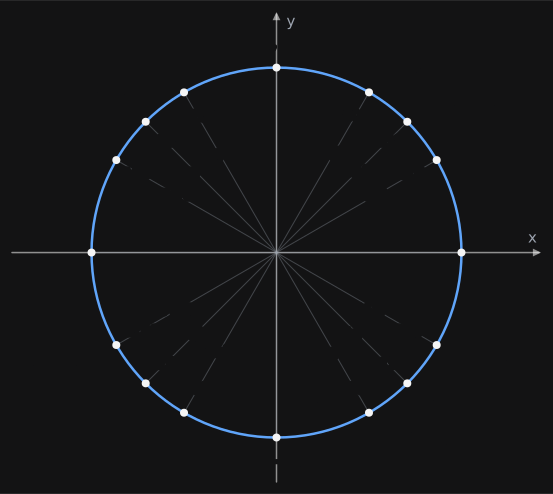
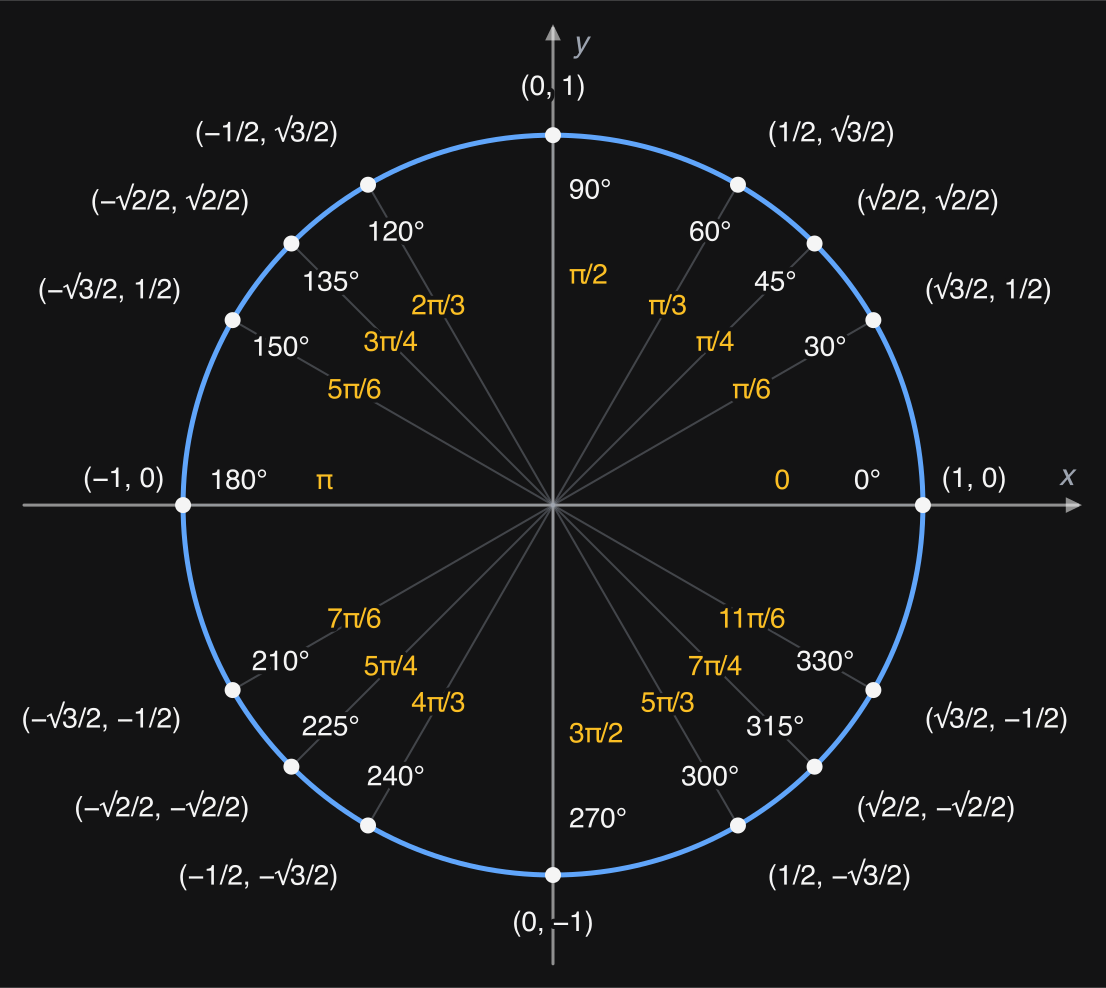
The unit circle chart marks the 16 angles trigonometry uses most: every multiple of 30° and of 45° from 0° to 330°. Each point is labeled (cos θ, sin θ), and tan θ is sin θ divided by cos θ.
| Degrees | Radians | cos θ | sin θ | tan θ |
|---|---|---|---|---|
| 0° | 0 | 1 | 0 | 0 |
| 30° | π/6 | √3/2 | 1/2 | √3/3 |
| 45° | π/4 | √2/2 | √2/2 | 1 |
| 60° | π/3 | 1/2 | √3/2 | √3 |
| 90° | π/2 | 0 | 1 | undefined |
| 120° | 2π/3 | −1/2 | √3/2 | −√3 |
| 135° | 3π/4 | −√2/2 | √2/2 | −1 |
| 150° | 5π/6 | −√3/2 | 1/2 | −√3/3 |
| 180° | π | −1 | 0 | 0 |
| 210° | 7π/6 | −√3/2 | −1/2 | √3/3 |
| 225° | 5π/4 | −√2/2 | −√2/2 | 1 |
| 240° | 4π/3 | −1/2 | −√3/2 | √3 |
| 270° | 3π/2 | 0 | −1 | undefined |
| 300° | 5π/3 | 1/2 | −√3/2 | −√3 |
| 315° | 7π/4 | √2/2 | −√2/2 | −1 |
| 330° | 11π/6 | √3/2 | −1/2 | −√3/3 |
Besides 0 and ±1, the coordinates use only three numbers: 1/2, √2/2 and √3/2. The angle decides which one, and the quadrant decides the sign.
How do radians work on the unit circle?
On the unit circle, an angle in radians is the distance the point travels along the circle. A full turn covers the whole circumference, 2π × 1 = 2π, so 360° is 2π radians and 180° is π radians.
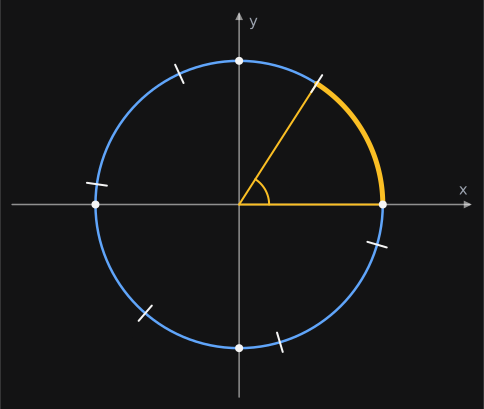
To change degrees to radians, multiply by π over 180. To change radians to degrees, multiply by 180 over π.
The special angles are simple fractions of π: 30° = π/6, 45° = π/4, 60° = π/3 and 90° = π/2. Count around the circle in those steps. 150° is five 30° steps, so it is 5π/6, and 225° is five 45° steps, so it is 5π/4.
One radian is about 57.3°, a little less than 60°. Calculus works in radians because they are the unit in which the derivative of sin x is exactly cos x.
Where do the unit circle values come from?
Apart from the points on the axes, every exact value on the unit circle comes from two special right triangles, the 45-45-90 and the 30-60-90, drawn inside the circle so that the hypotenuse is the radius, 1.
- 45-45-90 triangle. It is half of a square, so its two legs are equal. With hypotenuse 1, each leg is √2/2 (about 0.707), so the point at 45° is (√2/2, √2/2).
- 30-60-90 triangle. It is half of an equilateral triangle, so its short leg is half the hypotenuse: 1/2. The long leg is √3/2 (about 0.866). Lying down at 30°, it gives the point (√3/2, 1/2); standing up at 60°, it gives (1/2, √3/2).
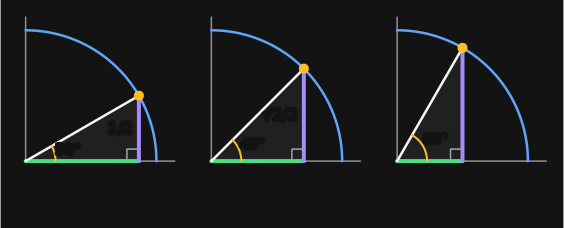
Each point passes the circle's test. At 30°, (√3/2)² + (1/2)² = 3/4 + 1/4 = 1. The angles on the axes need no triangle: 0° is (1, 0) and 90° is (0, 1).
How do you find unit circle values in other quadrants?
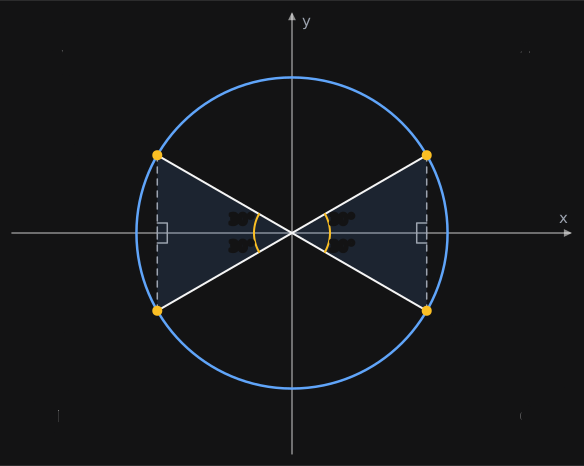
To find a unit circle value in another quadrant, use the reference angle for the numbers and the quadrant for the signs. Every point outside the first quadrant is a mirror image of a first-quadrant point, so its coordinates are the same up to sign. The reference angle is the acute angle between the terminal side and the x-axis.
| Quadrant | θ between | Reference angle | (cos θ, sin θ) | Positive |
|---|---|---|---|---|
| I | 0° and 90° | θ | (+, +) | sin, cos, tan |
| II | 90° and 180° | 180° − θ | (−, +) | sin |
| III | 180° and 270° | θ − 180° | (−, −) | tan |
| IV | 270° and 360° | 360° − θ | (+, −) | cos |
The signs come straight from the axes: x, which is cosine, is negative left of the y-axis, and y, which is sine, is negative below the x-axis. The memory aid ASTC, often said as "All Students Take Calculus", lists what is positive in quadrants I to IV: All, Sine, Tangent, Cosine.
- 1Find the quadrant. 120° is between 90° and 180°, so it is in quadrant II.
- 2Find the reference angle, measured to the x-axis: 180° − 120° = 60°.
- 3Take the reference angle's point: (1/2, √3/2).
- 4Apply the quadrant's signs. In quadrant II, x is negative and y is positive, so the point at 120° is (−1/2, √3/2).
How do you find tan on the unit circle?
To find tan θ on the unit circle, divide the point's y-coordinate by its x-coordinate. Since the point is (cos θ, sin θ), tan θ = sin θ / cos θ. At 60° the point is (1/2, √3/2), so tan 60° = (√3/2) ÷ (1/2) = √3.
Tangent of θ is sine of θ over cosine of θ, which is the point's y-coordinate divided by its x-coordinate.
y/x is rise over run, so tan θ is the slope of the terminal side. The line through the origin and the point meets the vertical line x = 1, which touches the circle at (1, 0), at height tan θ: a length on a line tangent to the circle, which is where the name tangent comes from.
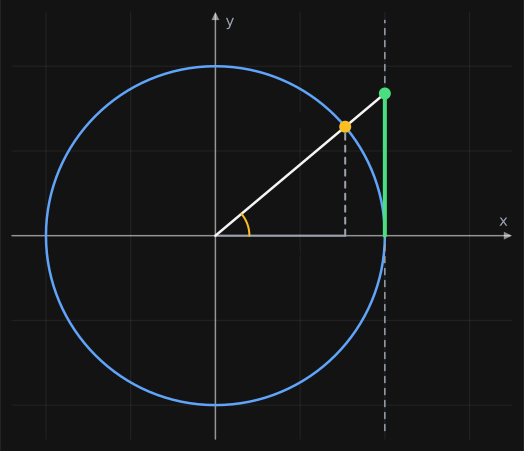
Tangent is undefined at 90° and 270° (π/2 and 3π/2). There cos θ = 0, so sin θ / cos θ would divide by zero, and the terminal side is vertical, parallel to x = 1, so it never meets that line. Tangent is 0 at 0° and 180°, where sin θ = 0.
Tangent is positive where sine and cosine have the same sign, in quadrants I and III, and negative in quadrants II and IV. The first-quadrant values are tan 30° = √3/3 (the same as 1/√3), tan 45° = 1 and tan 60° = √3.
How do you memorize the unit circle?
To memorize the unit circle, learn only the first quadrant and work out the rest. Besides the four points on the axes, the points at 30°, 45° and 60° are the only ones to learn: every other point on the chart is one of these three mirrored, with signs set by the quadrant.
| Angle | sin θ | cos θ |
|---|---|---|
| 0° | √0/2 = 0 | √4/2 = 1 |
| 30° | √1/2 = 1/2 | √3/2 |
| 45° | √2/2 | √2/2 |
| 60° | √3/2 | √1/2 = 1/2 |
| 90° | √4/2 = 1 | √0/2 = 0 |
Read down the sine column: the number under the root counts 0, 1, 2, 3, 4, always over 2. Cosine is the same list in reverse.
The hand trick stores the same pattern. Hold up your left hand, palm toward you, and give the fingers the angles 0°, 30°, 45°, 60° and 90°, from pinky to thumb. Fold down the finger for your angle. Then sin θ is √(fingers on the pinky side) / 2 and cos θ is √(fingers on the thumb side) / 2. For 60°, fold the index finger: 3 fingers on the pinky side give sin 60° = √3/2, and 1 on the thumb side gives cos 60° = 1/2.
To fill in a blank unit circle from memory:
- 1Mark the points on the axes: (1, 0) at 0°, (0, 1) at 90°, (−1, 0) at 180° and (0, −1) at 270°.
- 2Fill in quadrant I from the pattern: (√3/2, 1/2) at 30°, (√2/2, √2/2) at 45° and (1/2, √3/2) at 60°.
- 3Mirror quadrant I across the y-axis into quadrant II, at 150°, 135° and 120°, by making each x negative.
- 4Mirror the top half across the x-axis into quadrants III and IV by making each y negative.
- 5Label the radians in steps of π/6 and π/4: 150° is 5π/6, 210° is 7π/6, 225° is 5π/4 and 330° is 11π/6.
Worked examples
Sine and cosine of 210°
Find the exact values of and .
- 1Place the angle: 210° is between 180° and 270°, so its point is in quadrant III, below and to the left of the origin.
- 2Find the reference angle: .
- 3The point at 30° is .
- 4In quadrant III both coordinates are negative, so the point at 210° is .
- 5Sine is the y-coordinate and cosine is the x-coordinate.
Answer: and
Tangent of 3π/4
Find the exact value of .
- 1Convert to degrees: , which is in quadrant II.
- 2Find the reference angle: , or .
- 3The point at 45° is . In quadrant II, x is negative, so the point at is .
- 4Divide y by x: .
Answer:
An angle on an axis: 3π/2
Find , and .
- 1 is three quarters of a full turn of , which is 270°: straight down.
- 2The point straight down on the unit circle is .
- 3Cosine is the x-coordinate, so . Sine is the y-coordinate, so .
- 4Tangent would be , a division by zero.
Answer: , , and is undefined.
A negative angle: −π/3
Find and .
- 1A negative angle turns clockwise. is 60° clockwise from the positive x-axis, which ends in quadrant IV.
- 2It ends at the same point as , which is 300°.
- 3Its reference angle is 60°, and the point at 60° is .
- 4In quadrant IV, x is positive and y is negative, so the point is .
Answer: and
Working backward: sin θ = 1/2
Find every angle with where .
- 1Sine is the y-coordinate, so look for the points on the unit circle at height .
- 2The horizontal line crosses the circle twice: once in quadrant I and once in quadrant II, the two quadrants where sine is positive.
- 3In quadrant I, , so one answer is , or 30°.
- 4In quadrant II, the angle with reference angle is , or 150°.
Answer: or
A point that is not a special angle
Show that is on the unit circle, then find , and for the angle that ends there.
- 1Check the equation: , so the point is on the unit circle.
- 2Cosine is the x-coordinate: .
- 3Sine is the y-coordinate: .
- 4Tangent is y over x: .
- 5A calculator finds the angle itself: .
Answer: , and , with
Check yourself
1.What are the coordinates of the point at 60° on the unit circle?Show answer
(1/2, √3/2)
2.On the unit circle, is sine the x-coordinate or the y-coordinate?Show answer
The y-coordinate. Cosine is the x-coordinate.
3.What is sin 45°?Show answer
√2/2, about 0.707
4.What is cos π?Show answer
−1. The point at π, or 180°, is (−1, 0).
5.What is tan 30°?Show answer
√3/3, which is the same as 1/√3
6.What is 225° in radians?Show answer
5π/4
7.What is 5π/6 in degrees?Show answer
150°
8.What is the reference angle of 150°?Show answer
30°, because 180° − 150° = 30°
9.In which quadrant are sine and cosine both negative?Show answer
Quadrant III, between 180° and 270°
10.What is sin 330°?Show answer
−1/2
11.What is cos(2π/3)?Show answer
−1/2
12.Why is tan 90° undefined?Show answer
cos 90° = 0, so tan 90° = sin 90° / cos 90° would divide by zero.
13.At what angle between 0° and 360° is the point (√3/2, −1/2) on the unit circle?Show answer
330°, or 11π/6
Common mistakes
- Swapping sine and cosine, as in writing the 30° point as (1/2, √3/2).The point is (cos θ, sin θ), x first. At 30° the point is low and far to the right, so the larger number is x: (√3/2, 1/2).
- Keeping the first-quadrant sign in another quadrant, as in sin 210° = 1/2.Find the quadrant before writing any number. 210° ends below the x-axis, where y is negative, so sin 210° = −1/2.
- Measuring the reference angle to the y-axis, as in giving 120° a reference angle of 30°.Reference angles are measured to the x-axis: 180° − 120° = 60°, so 120° takes the 60° values and its point is (−1/2, √3/2).
- Writing tan θ as cos θ / sin θ.Tangent is rise over run, y over x: tan θ = sin θ / cos θ. The ratio with cosine on top is cot θ.
- Leaving a calculator in radian mode, so sin 30 comes out as about −0.988.Check the mode first. In degree mode sin 30° = 0.5. In radian mode, enter sin(π/6) instead.
- Measuring angles clockwise, or starting from the y-axis.Angles start on the positive x-axis and turn counterclockwise. Only negative angles turn clockwise, so −90° points straight down, the same as 270°.
Questions students ask
Why is the unit circle important?
It defines sine, cosine and tangent for every angle, not just the acute angles inside a right triangle. That is what lets trigonometry describe rotation and anything that repeats. Trig identities, radian measure and the graphs of sine and cosine all start from it.
Why does the unit circle have a radius of 1?
A radius of 1 makes every hypotenuse drawn from the center equal to 1, so sine and cosine stop being ratios and become plain coordinates: sin θ = y/1 = y and cos θ = x/1 = x. A circle of radius r works too, but its point at angle θ is (r cos θ, r sin θ), so every value carries an extra factor of r.
Does the unit circle have a diameter of 1?
No. The unit circle's radius is 1, so its diameter is 2 and its circumference is 2π. That circumference is why a full turn is 2π radians.
Why does the unit circle go counterclockwise?
It is a convention: positive angles turn counterclockwise from the positive x-axis, so a growing angle passes through quadrants I, II, III and IV in order. Clockwise turns are negative angles. For example, −90° ends straight down, at the same point as 270°.
How do negative angles and angles over 360° work on the unit circle?
A negative angle turns clockwise, and an angle over 360° goes around more than once. Add or subtract 360°, or 2π, until the angle is between 0° and 360°: −30° ends at the same point as 330°, and 390° ends where 30° does. Angles that end at the same point are called coterminal, and they have the same sine, cosine and tangent.
What are sec, csc and cot on the unit circle?
They are built from the point (x, y): sec θ = 1/x, csc θ = 1/y and cot θ = x/y. At 60° the point is (1/2, √3/2), so sec 60° = 2, csc 60° = 2/√3 = 2√3/3 and cot 60° = √3/3. Each is undefined where its denominator is 0, so sec is undefined at 90° and 270°, and csc and cot at 0° and 180°.
Is the unit circle used in calculus?
Yes. Calculus measures angles in radians, which are arc lengths on the unit circle, and the derivatives of sine and cosine are proved from it. The key limit, sin x / x approaching 1 as x approaches 0, comes from comparing the areas of a triangle, a sector and a larger triangle drawn on the unit circle.
How is the unit circle related to the graph of sine?
The graph of y = sin x plots the height of the point as it travels around the unit circle, with the angle in radians along the horizontal axis. One full turn is 2π, so the graph repeats every 2π, and it stays between −1 and 1 because the radius is 1. The graph of cosine plots the point's x-coordinate the same way.
What is the unit circle used for in real life?
Anything that turns or repeats. A point on a wheel of radius r, turned through an angle θ, sits at (r cos θ, r sin θ), the unit circle scaled up, and computer graphics rotate shapes with the same cos θ and sin θ. Sine and cosine waves also describe sound, alternating current and other vibrations.
Is the unit circle hard to learn?
It looks like 48 values, but it is built from three numbers, 1/2, √2/2 and √3/2, plus 0 and 1. Learn the first-quadrant points at 30°, 45° and 60°, then get the rest by mirroring them, choosing each sign from the quadrant. Tangent is sine divided by cosine.
Sources
Keep going
All math topicsGeometry
The Pythagorean theorem, explained visually
The Pythagorean theorem says that in a right triangle, the square of the hypotenuse (the side across from the right angle) equals the sum of the squares of the other two sides: a² + b² = c². For legs 3 and 4, the hypotenuse is 5, because 9 + 16 = 25.
Linear Algebra
The dot product, explained visually
The dot product of vectors a and b is a number: multiply matching components and add, so (1, 4) · (4, 3) = 1 × 4 + 4 × 3 = 16. It also equals |a||b| cos θ, the length of a's shadow on b times the length of b. It is positive when the angle θ between them is acute, zero when it is 90° and negative when it is obtuse.
Calculus
What is a derivative?
A derivative is the slope of a curve at a single point: how fast the function's output is changing at that exact input. Draw a line through two points on the curve and slide one point toward the other; the slope the line settles on is the derivative. For f(x) = x², the derivative is 2x, so the slope is 2 at x = 1.